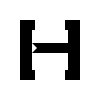
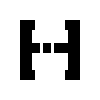
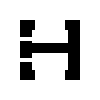
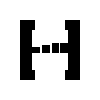
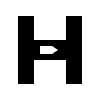
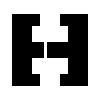
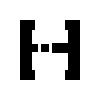
The added layer: a quantized signal rhythm and a left→right resolution — raw input enters as discrete cells, is processed across the bridge, and exits as a single solid form. The cue is built into the geometry (crossbar and the fragmented→solid axis), never applied as ornament. No circuits, nodes, chips, numbers or letters.
All cues are designed to simplify into a clean H at 16px; hml-v5-favicon-ml is the dedicated small-size carrier.
Reference — prior H-bracket marks (no ML cue)
h-bracket-v6-lockup-symbol
h-bracket-v5-favicon
h-bracket-v4-negative-space
New — ML communication variants
V1 — Signal Bridgehml-v1-signal-bridge.svg
B / W — W / B
100
32
16
100
32
16
RationaleKeeps V6 intact; turns the crossbar into a bridge that carries signal across the H.
How the cue worksTwo discrete input cells (left) become one solid output segment (right) — discrete signal resolving to structure, read inside the bar.
16px legibilityGood; the 3px gaps close and it reads as a near-solid H crossbar.
RiskThe two equal cells can read as "dashes" rather than input if spacing drifts; keep gaps tight.
RecommendationStrong, calm option; close cousin of V6 — pick one as the primary.
V2 — State Transitionhml-v2-state-transition.svg
B / W — W / B
100
32
16
100
32
16
RationaleThe H itself transforms — no extra element added to the bar.
How the cue worksFragmented/open left stem (raw input) resolves into a solid right stem (structured output); the crossbar is the structuring moment.
16px legibilityAcceptable; gaps close to a solid H — the transition is a 100/32px asset.
RiskBroken stem can read as "damage" rather than intent if gaps are too wide.
RecommendationBest for motion / "build" states; secondary to V6 as a static primary.
V3 — Encoded Crossbarhml-v3-encoded-crossbar.svg
B / W — W / B
100
32
16
100
32
16
RationaleEncodes "processed communication" directly in the bar, leaving the H frame clean.
How the cue worksA short quantized rhythm of cells rising in height left→right — signal being resolved, without numbers or barcode regularity.
16px legibilityWeakest at 16px; height steps flatten into a slightly ragged bar. Defer small sizes to V5.
RiskMost likely to read as decoration/equalizer if cell count grows; keep to 4 and bottom-aligned.
RecommendationUse at 100px+ (web header, splash); not the favicon.
V4 — Negative Flowhml-v4-negative-flow.svg
B / W — W / B
100
32
16
100
32
16
RationaleBold H where the cue is subtracted, not added — most premium and ownable.
How the cue worksA carved channel opens on the left and tapers to a rightward point — left→right flow expressed purely as negative space.
16px legibilityStrong silhouette; void closes below ~20px and it becomes a solid bold H.
RiskThe flow meaning is invisible at favicon size; relies on the family to carry it.
RecommendationTop hero candidate beside V6 for large/brand use.
V5 — Favicon MLhml-v5-favicon-ml.svg
B / W — W / B
100
32
16
100
32
16
RationaleHeaviest silhouette, no fragile detail — built to win at 16px.
How the cue worksOne narrow gap splits the bar into a small input block and a larger output block; minimal, but enough to imply input→output at 32px.
16px legibilityBest of the set; the gap closes and it reads as a solid bold H with bracket feet.
RiskCue is the most reduced; only the split survives, and only above ~24px.
RecommendationAdopt as the app-icon / favicon master, paired with V6 at large size.
V6 — Mastermarkhml-v6-mastermark.svg
B / W — W / B
100
32
16
100
32
16
RationaleThe integrated hero: H + brackets + machine communication + input→output as one calm symbol.
How the cue worksTwo small input cells grow and resolve into a dominant solid output block; weight favours the output to say "structured result."
16px legibilityStrong; the cells simplify into a bar, the H stays clean.
RiskClose in spirit to V1 — the difference is the deliberate output-weighting; pick the proportion you prefer.
RecommendationPrimary master mark — take to Illustrator first; pair with V5 for favicon.